Page 5
In July 2023 a young painter came to Hornafjörður to paint himself into what was at that time a 110 year old tradition. He put up a tent on Hrossó, or Hrossabitahagahól (The hill where horses bite the grass) without realizing he was on the most welltrodden path of Hornafjörður, that is to say the frisbygolf-field in Höfn.
'I am in the middle of a folf track. People are folfing into my tent and over it. I try to paint the folfers and some like it, while others don´t. But they are my only company, ' Almar said in an interview with the newssite visir.is shortly after the performance started to attract attention.
Page six
Diary 16th july
Now I have lived for about a week in Hornafjordur and painted the landscape as commissioned by the Art Museum of Svavar Guðnason.
If you are on the way through Höfn and surroundings you should drop by for a coffee.
The weather has been rather harmless and boring and doesn't seem to let up.
The pictures of me are painted by Bergur Nordal, but he was here with me for the first few days and performed quality control of the painting as well as doing registration work and being available for general hands-on therapeutic help which was much needed.
Following is a rather spiritual and juicy excerpt from a diary entry:
"Day 3. Sunday. July 16.
Now it turns out that the irritation of the morning was not a traditional party aftershock.
After firing my assistant and sending him to Reykjavík, I shat myself.
So, when I was in the middle of getting rid of the useless underwear, the curator decided to pay a courtesy visit because the "calm" is now blowing over Hornafjörður at twenty meters per second.
I threw up over the curator and sent him running from the vomit.
Later that night, when I was lying in a panic attack, my assistant crawled back into the tent. I don't think he can afford the rent in Reykjavík. Through my feverdream I could see him painting an oil painting of me.
I have water coming out of both ends, but my assistant paints and paints.
He paints and paints and paints but inspiration never comes over me.
Day 4. Monday 17 July.
I have now destroyed 3 pairs of underwear in this exile.
My assistant could not be happier.
I sleep and hang out by the public toilet at the Olís station alternately.
In the afternoon I freshen up, cook soup and the assistant insists on painting in the evening light.
It's noisy and the images blow across the barren moor. The easel hits me in the face.
I throw up and paint an unusable picture.
The assistant paints a masterpiece.
I suspect him of poisoning me..."
(Source: https://www.facebook.com/almarr.s.atlason 23d july)
Page eight
Almar´s assistant was none other than Bergur Nordal which had recently returned from Vienna where he had spent many years studying at a künste-akademy. But after a short stay, Bergur abandoned the tent, and now Almar was alone on top of the hill, as had been the original plan.
What did this hermit intend to do?
According to him this was done in remembrance of hundred and ten years passing since the painter, Ásgrímur Jónsson, visited southeastern Iceland, and the introduction of the painting in Hornafjordur.
This is not altogether wrong. In the biography of Ásgrímur Jónsson one can read that Ásgrímur did paint in southeastern Iceland from 1910 to 1912, and in the year 1912 he came to Hornafjordur and stayed there for a month, living in a tent. This visit is an important benchmark in Ásgrímur´s career as a painter. 'The skill which Ásgrímur had attained in the use of water-colours in his pictures from Hornafjordur was in his consideration a threat to him as an artist and so he decided to stop now that he had reached these heights.'
The next decades after Ásgrímur´s visit to Hornafjordur, the interest in the area for paintings was unusually high. The clearest and most obvious example is Jón Þorleifsson who decided after witnessing Ásgrímur in the field to head to Denmark to study art, just like Ásgrímur had done. But more young men picked up the brush. Bjarni Guðmundsson who later headed the coop, Bjarni Guðjónsson from Lón, Karl Guðmundsson from Þinganes, and then the painters Höskuldur Björnsson and Svavar Guðnason. 'It has been said that Hornafjörður did a lot for the visual arts in the past, before it spread to every corner of Iceland like trawler fishing.' (
Svavar Guðnason in Tíminn, 1975 ). One thing though is certain, Hornafjordur gave Iceland two great pioneers, Jón Þorleifsson, the first professional art-critic and Svavar, the first abstract painter.
Page nine
Almar made direct references to these amateurs and grand masters in an interview with Morgunblaðið:
I call it the Hornafjordur-school, and in my opinion, it is here where the Icelandic painting was born and in many ways here is a richer tradition than in Reykjavík.
Despite having created more obstacles for aspiring folfers, and having been awfully sick the first week on the hill, Almar was well received in Hornafjordur. According to oral sources he organized a karaoke-evening at Hafið, which at the time was the only bar in Höfn. He is also rumoured to having had many guests in the tent who took selfies with the artist. An exhibition was held in september 2023 of works which he painted that summer, but very few have been preserved. In the beginning the artist aimed at painting 100 works that summer, but more probable is that they were 40-50 by the end of the month.
Page twelve
Tómarúm – the mysterious fishtub-tower
It was not only an eccentric camper in the middle of a folf-track which caused bewilderment and shock in Hornafjordur. Twenty-second of june a tall tower made from disused fishtubs rose in the middle of Höfn. It stood over Humarhátíð (lobsterfestival) which was held that same weekend and for a few weeks more when it disappeared as suddenly as it had appeared. Shortly after the disappearance an article appeared in Morgunblaðið about stolen artwork.
'We go on vacation and then get a message from the artist, who apparently knows some people that had been intending to come and see the work, that the work has vanished,' said Lind D. Völundardóttir, which at the time was the principal of the secondary school, FAS, and one of the owners of the gallery MUUR. The tower was an installation made by Áslaug Thorlacius, named Tómarúm (emptiness). In an interview with the same newspaper, the artist explained that the work was meant to reflect the beauty of everyday life, because fishtubs are like many other things, often right before people´s own eyes.
It seems that this emphasis on everyday life was what caused the disappearance. An anonymous person in a chat with Morgunblaðið told the journalist that he/she would not have considered fishtubs in a fishingvillage as work of art and had removed the artwork for fear of accidents.
It is impossible to take the performance of Almar Atlason out of this context. A lot of debate and arguments had sprung in Hornafjordur about the value of letting artists break up everyday-life with their antics. In a very harshly worded column in Eystrahorn (a local newsletter) the columnist even writes about the shitty nature of art.
Sources:
Listaverki stolið í skjóli nætur,
Segir slysahættu hafa blasað við,
Vill að listaverkið fái að standa óáreitt
Page thirteen
Málfríður malar
Finally Eystrahorn is no longer on summerholiday. I have been waiting to express my opinion and other citizens of Hornafjordur. What has been on people´s minds this summer are artworks and performances. Number one: 'the artwork' aka bound, miscoloured fishtubs on the grassfield by Nettó. You could say that 99,7% of inhabitants had no clue this was a 'work of art'. Most people thought here was some kind of training track built by the Humarhátíð-committee because the tower rose at the same time Humarhátíð(lobsterfestival) started. But no, it came to light on mbl.is that here was a work of art when citizens were accused of stealing it, and according to the article one might think it happened in the dead of night. These public accusations to locals brought forth various reactions, some were angry and hurt, others could laugh it offf. We can be happy that the town got some free advertisements and that noone got hurt since the artwork was removed before it caused any trouble.
Number two: 'performance' in the middle of the folf-track on Hrossabitahagi. What the hell is going on? This performance is NOT AT ALL funny, and hopefully not funded by taxpayers. Art has it´s value in all kinds of shapes and the idea to remember Ásgrímur that painted here for about a century ago, is fine. But to put a tent with imperfect tidiness in the middle of a walkingpath/sport field, is disrespecting both towards tourists and locals that want to use the field when the weather is good. You could maybe call this, the shitty nature of art?
The column originally appeared 10th of august in Eystrahorn. The author is unknown but likely Barði Barðason, then the husband of the editor, Arndís Lára Kolbrúnardóttir, is the likely pen behind Málfríður.
Sources:
Málfríður malar
Page fourteen
Almar- a biography
Almar was born on midnight Friday the thirteenth in october 1992, but registered as Saturday the fourteenth. In his early years he lived with his parents and sister in a small wooden cottage on Grettisgata, until it burnt down. After that the family wandered around, and lived with friends and distant family until Almars parents managed to find a house in Elliðaárdalurinn. At this time, and later in his life, Almar stayed with his grandparents in Hveragerði where his passion for landscape-painting was born. Early on, Almar painted the flowers in his grandmother´s garden in exchange for candy and icecream, but a painting made in his early youth of Herðubreið, which he made thirteen year old while camping with his parents, has been preserved.
Almar had difficulties staying in any school he attended and his time in college ended abruptly when he was kicked out of the Flensborg-college in Hafnarfjordur. After that he spent a long time on the road. 'It was as if a the veil between me and reality had been torn apart and that I was now free to roam' he later recalled.
The incident that shortened Almar´s stay in school so violently was a prank with a fire-extinguisher. Supposedly Almar sprayed water over some co-students as well as the vice-principal. After this accident Almar voyaged with his dear friend, Sigurgeir B. Þórisson, later architect and business men, hitchhiking all across Europe and Asia. Almar lost most of his funds in a casino in Kuala Lumpur and stayed illegally on the streets of Malasya for aproximately five months before getting on a yacht to Hong Kong where he got a money transfer from an anonymous benefactor. At the time, Sigurgeir had long since returned home, but by coincidence Almar met another aquiantance from Flensborg, Brand-Loki Guðbrandsson in Tanzania.
Page sixteen
After three years running around Europe and Asia and one year in Africa, Almar returned to Iceland. It was in Africa where he rediscovered his passion for water-colours. Watercolours of the animals of the serengeti have been preserved, which despite being amateurish have their charm.
Page sixteen, lower half
In the year 2023 a road was constructed through Hornafjordur, and the hill Topphóll in Dilksnes was removed as part of that road-construction. According to an interview with Hildigerður Skaftadóttir (b.1944) her grandmother Lovísa Eymundsdóttir (b.1874) always spoke of the hill as an elf-church. Now very little remains of that hill but possibly this painting shows the moment when it was torn apart. Dilksnes is one of the oldest settlements in southeastern Iceland, and is known to have existed as far back as the 16th century. However, one can proabably assume that the elves have been there for even longer.
Page seventeen
In the year 2014 Almar got engaged to Salka Valsdóttir and went to his first rehabilitation. After rehab he applied to the drama-department in the Artacademy of Iceland, but at the last moment he was convinced to become a visual artist instead. In the entrance-exam he tatooed a portrait of the one of the examiners on his left arm, which convinced the entrance-committee to give Almar one of the biggest scholarships in the history of the school.
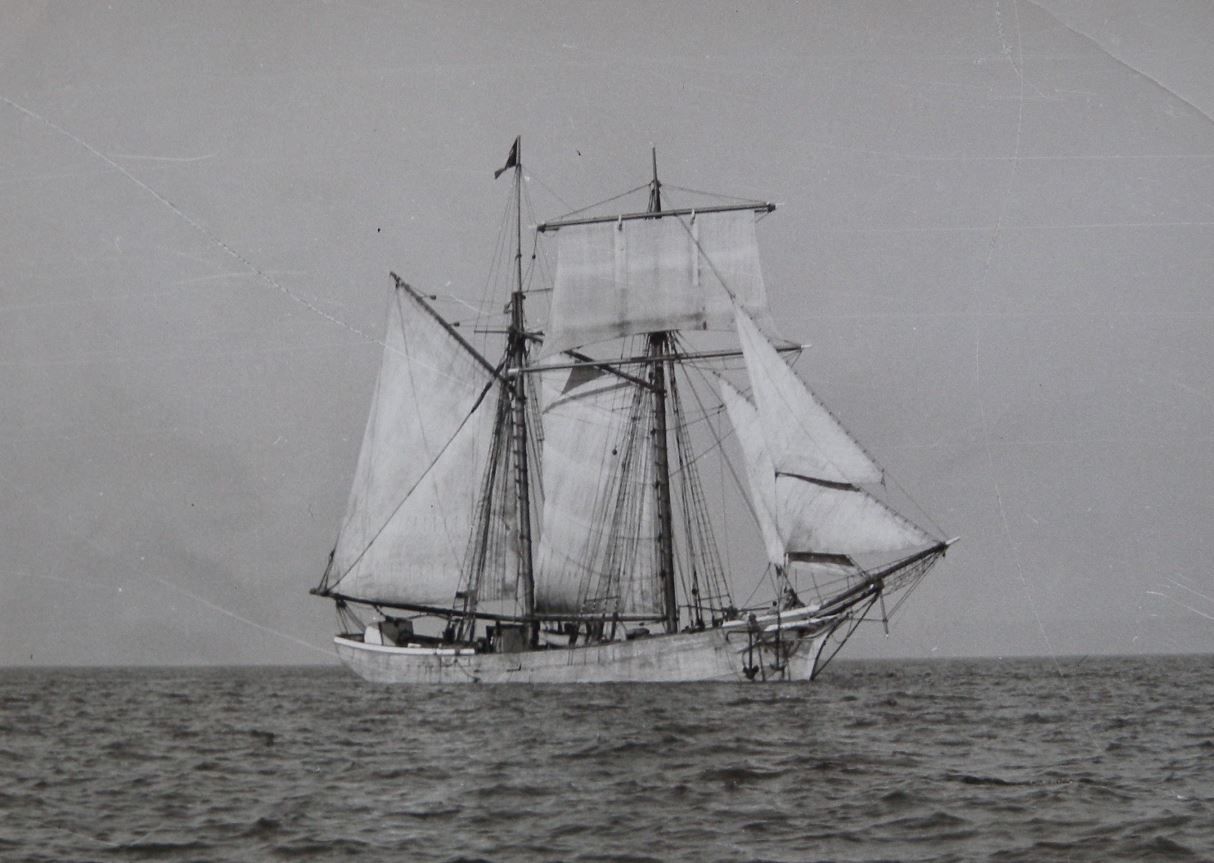
'Truth be told, I wanted to become a sailor, but I could not imagine how I would make a living doing that, so I chose art.'
The rest of the story, many know. In the art-academy Almar grabbed the attention of the nation when he lived naked inside a glassbox for a whole week. Sometimes as many as thousand Icelanders were watching him, which might be one of the highest rating for a live stream of an Icelandic performance in the 21st century.
After graduating from the academy he held a soloshow in Midpunkt where he sawed through a kitchen-aid machine in a performance named 'búskipti' (settlement). Almar was newly divorced and moved in with his future wife, the poetess, Birna Stefánsdóttir. (It is not unlikely that Birna may be seen at one painting of the catalogue, page 9).
A year later, 2020, Almar exhibited 50 paintings from the island Reunion in the gallery MUTT. Almar also caused quite a stir in the biannual, Head to head in Athens and with his performance, Brjálað að gera (enough to do) in Kling&Bang.
For now this enumeration will not continue. It is safe to assume that Almar performed and exhibited in various other places, although documentation is scant. Possibly, Almar was tattooed by renowned actor, Ingvar E. Sigurðsson, in Tjarnarbíó-theatre in the fall of 2019, although it cannot be confirmed.
Page eighteen
'This same summer, 2023, I spent a while in Öræfi and at Fagurhólsmýri with Eva Bjarnadóttir, artist and regional leader. She was very helpful and I felt deeply grateful for the hospitality.
How the nature is magnificent there, Ingólfshöfði is a peculiar island on dry land, and the land around Svínafell, ancient, slopes full of trees and forest, and tourists in every ravine. But for my naiveness, no mountain is as much of a mystery as Öræfajökull. The most dangerous volcano in Iceland reminds me of nothing so much as a tussock covered in dog urine.
'Tussock, tussock, tussock,' I yelled at the mountain and it shuddered as if I had been conjuring up ancient memories of public drunkeness in Lækjartorg.
Me and Eva held a waffle-party where I painted landscapes on each waffle with chocolate, jam and cream, and captured maybe a bit better the magnificence of the tussock, than in my paintings.'
From the diary of Almar Atlason.